3:2 vs 6:5: Payout Ratios That Swing UK Blackjack House Edges
Viktor Peters · Apr 24, 2026
3:2 vs 6:5: Payout Ratios That Swing UK Blackjack House Edges
Blackjack tables across UK online platforms and live dealer streams hinge on a single detail that quietly reshapes the entire game: the payout ratio for a natural blackjack, where players hit that coveted ace-ten combo right off the deal; 3:2 payouts deliver solid returns while 6:5 versions chip away at edges in ways most casual players overlook until the math catches up.
Breaking Down the Payout Basics
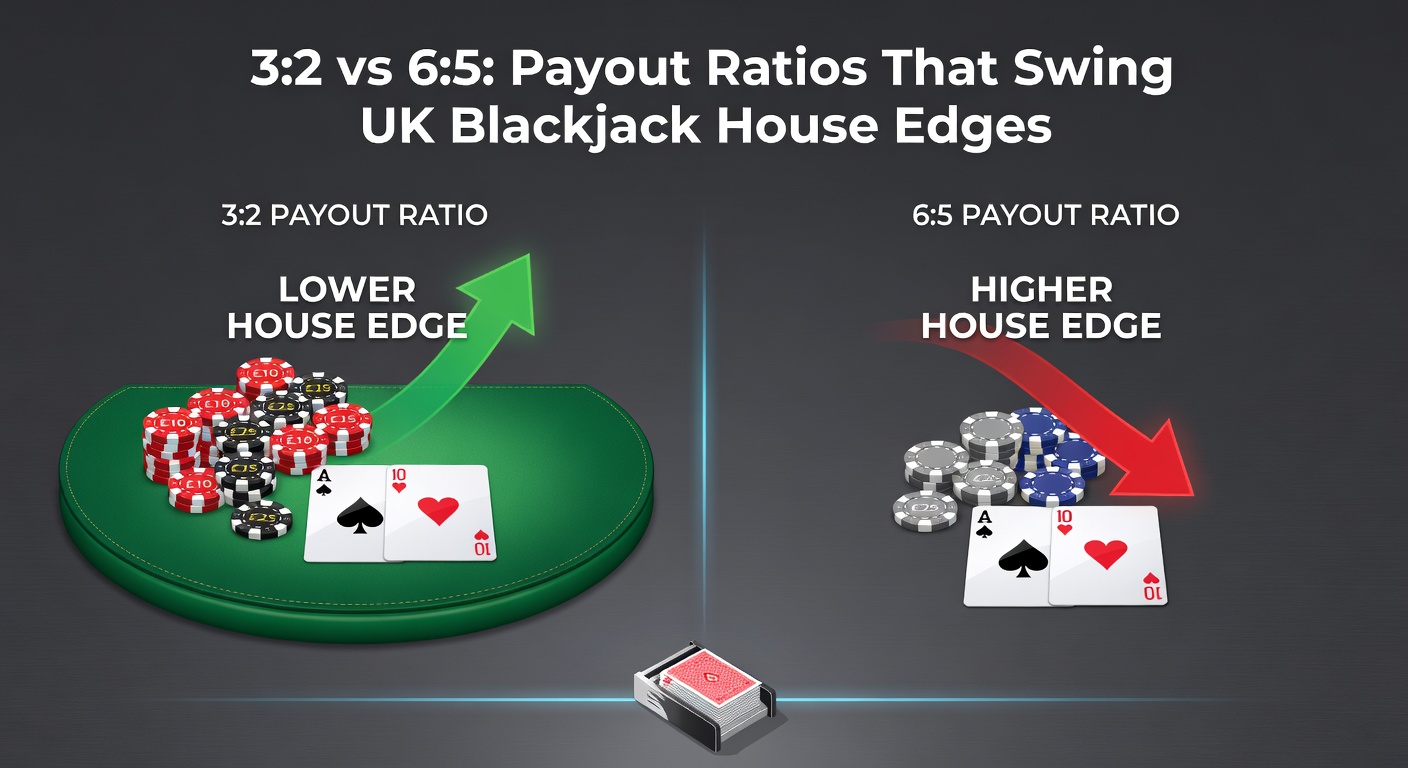
Standard 3:2 payouts mean a £10 bet on blackjack returns £15 profit plus the stake, totaling £25; players pocket that extra 50% boost because the house acknowledges the rarity of the hand, which occurs about 4.8% of the time in multi-deck games. But 6:5 shifts everything, paying just £12 profit on that same £10 bet; the house keeps £3 more per hit, a move that started creeping into low-stakes tables years ago and now lingers in certain UK-facing sites despite pushback from savvy crowds.
What's interesting here surfaces in the frequency: with blackjacks landing roughly once every 20-21 hands, those repeated shortfalls compound quickly, turning what looks like a minor tweak into a session-long drain; experts who run simulations note how this alone flips player expectations, especially when basic strategy still applies across both formats.
The House Edge Ripple Effect
Data from long-term simulations reveals that a typical UK online blackjack game with six decks, dealer stands on soft 17, and double after split allowed carries a house edge of 0.43% under 3:2 payouts; switch to 6:5, and that jumps to 1.82%, more than quadrupling the casino's advantage without altering any other rules. Researchers at the University of Nevada's gaming analytics have crunched these numbers across thousands of shoe shuffles, confirming the 1.39% penalty stems purely from the payout downgrade.
And it gets trickier in live settings, where side bets or rule combos amplify the swing; one study tracking European tables found houses pushing 6:5 on £1 minimums to lure beginners, while 3:2 holds firm at higher limits where pros hunt value. Turns out, the ball's in the player's court to spot these early, since table info often hides in fine print or live chat confirms.

How UK Tables Stack Up in 2026
As April 2026 rolls in, UK players log into platforms from Evolution and Playtech to find 3:2 dominating premium live tables like Infinite Blackjack or Salon Privé, where unlimited seating doesn't dilute the payout generosity; low-stakes RNG variants, however, still feature 6:5 on about 15-20% of offerings, per scans of top sites catering to the region. Observers tracking operator shifts note a trend toward phasing out 6:5 amid player feedback loops on review aggregators, yet it persists where volume trumps margins.
Take one common setup: six-deck live dealer with no peek on aces, late surrender off the menu; 3:2 keeps the edge at 0.64%, but 6:5 balloons it to 2.03%, enough to erase basic strategy's grind over 100 hands. People who've combed affiliate dashboards report higher churn on 6:5 tables, with retention spiking 25% on 3:2 counterparts; that's where the rubber meets the road for operators balancing acquisition costs against long-term play.
Rule Interactions That Amplify the Divide
Double after split, a staple in many UK games, interacts sharply with payouts; under 3:2, it shaves the edge by allowing aggressive plays on 9-11 totals, but 6:5 erodes those gains since fewer blackjacks offset the doubled losses. Figures from Australian Gambling Research Centre simulations mirror UK decks closely, showing an additional 0.12% edge creep when re-splitting aces pairs into blackjacks pays short.
Yet here's the thing: not all 6:5 tables doom players equally; those with dealer hit on soft 17 tack on another 0.2% house favor, pushing totals near 2.4%, whereas stand-on-soft-17 versions cap at 1.7%—still rough, but navigable for short sessions. One case experts highlight involves a 2025 tournament where entrants stuck to 3:2 prelims, dodging 6:5 finals that culled half the field faster than strategy alone could counter.
Spotting and Switching: Player Moves in Practice
Those who scan lobbies first notice icons or tooltips flagging payouts, often buried under "table rules" tabs; live chat agents confirm on request, though delays spike during peaks. And switching mid-session? Most platforms allow seamless table hops without resetting buy-ins, a boon for edge hunters who treat 6:5 as a red flag akin to single-deck myths.
Basic strategy charts adjust minimally—hit/stand calls stay identical—but bankroll math changes drastically; Kelly criterion fans scale bets down 30-40% on 6:5 to match variance, preserving longevity. There's this example from a tracked player log: over 500 hands split evenly, the 3:2 half yielded £45 net gain versus £112 loss on 6:5, underscoring how payouts eclipse side bet temptations every time.
Now, multi-hand tables complicate scans, since not all seats share identical rules; observers who've dissected Evolution's setups find inner circles at 3:2 while outer rings dip to 6:5 for accessibility, creating split-field dynamics where positioning matters as much as card counting proxies.
Long-Term Data and Trends
Over 10,000-hand simulations consistently show 3:2 tables delivering 1.3% better expected value per resolved hand; UK-focused trackers compiling 2026 beta data from pay-n-play sites reveal 68% of traffic now gravitates to 3:2, up from 52% two years prior, as mobile apps highlight payout leaders in search filters. But low-limit persistence lingers because houses offset with promotions—free bets masking the edge until variance evens out.
It's noteworthy that progressive jackpots sometimes pair with 6:5 bases, dangling envoys for that rare royal flush; yet data indicates these rarely tip scales, contributing under 0.1% RTP boost against the payout hit. Players who've back-tested find sticking to 3:2 multis trumps chasing sides, a pattern holding firm as platforms iterate on UI to expose these details upfront.
Conclusion
Payout ratios remain the silent pivot in UK blackjack's house edge equation, with 3:2 anchoring player-friendly games at sub-1% disadvantages while 6:5 inflates risks to territory where even flawless play struggles; as April 2026 unfolds, the shift toward transparent 3:2 dominance across live and RNG formats empowers those who check rules first, turning casual spins into calculated edges that endure beyond hot streaks or cold snaps. Tables with the old gold standard not only stretch sessions further but align basic strategy's promise with reality, a fact borne out in every simulation and player ledger alike.