Charting blackjack's rule ripple effects across UK table variants and digital shifts
Ines Peters · Jul 26, 2026
Blackjack Rule Adjustments Ripple Through UK Table Styles and Digital Evolutions
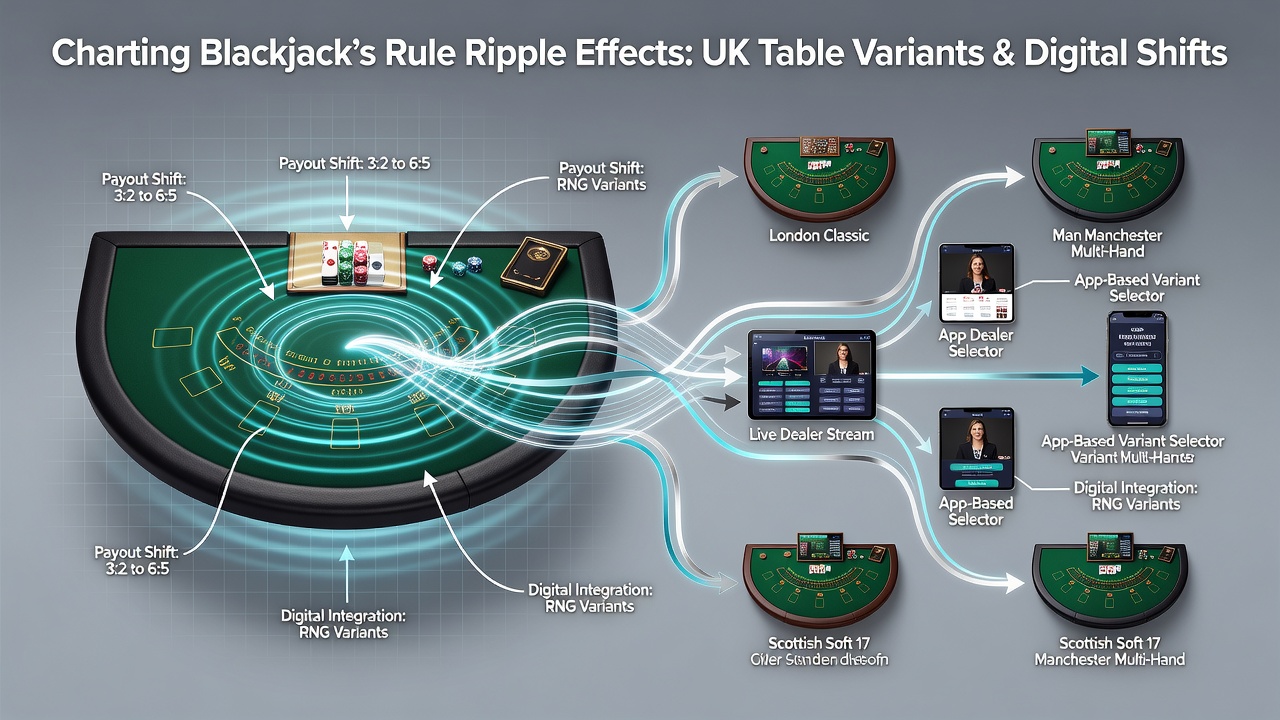
Blackjack rules create measurable shifts in house edges across UK table formats, and these adjustments extend into digital environments where software providers implement the same parameters at scale. Data from industry reports indicate that variations in deck count, dealer actions on soft seventeen, and doubling restrictions alter expected returns by fractions of a percent that compound over thousands of hands. Observers note these differences appear consistently between land-based venues in London and Manchester and their online counterparts operated through licensed platforms. Traditional UK tables often operate with six or eight decks while European-style games restrict doubling to hard totals of nine through eleven. Such constraints raise the house edge by 0.2 to 0.4 percent according to probability models published in gaming mathematics literature. In contrast, tables allowing double after split reduce that margin because players gain flexibility on paired hands. Researchers at academic institutions tracking casino mathematics have documented these patterns across hundreds of rule combinations and confirmed the effects remain stable regardless of venue type. Digital platforms replicate these rule sets through RNG systems yet introduce additional layers of variation. Some operators adjust deck penetration rates or shuffle frequencies to match land-based conditions, while others modify payout structures on side bets that accompany core games. Figures from European gaming associations reveal online blackjack sessions in the UK increased by 18 percent between 2024 and 2025, driven partly by players seeking specific rule combinations unavailable at nearby physical tables. By July 2026 analysts expect further migration as mobile interfaces incorporate real-time rule filters that let users sort tables by parameters such as number of decks or surrender availability. Multi-deck games dominate both physical and virtual UK offerings because they slow card counting and stabilize revenue for operators. Single-deck variants surface occasionally in high-limit rooms or specialized online lobbies, yet their lower house edges attract fewer tables overall. Those who study table distribution patterns report single-deck options represent less than 5 percent of active blackjack positions across major UK operators. The scarcity persists even though players recognize the mathematical advantage because operational costs and regulatory oversight favor multi-deck formats that reduce volatility. Dealer hit or stand decisions on soft seventeen produce another clear ripple. When dealers hit soft seventeen the house edge climbs by roughly 0.2 percent compared with stand-on-soft-seventeen rules. UK land-based casinos display this choice prominently on table signage, and online interfaces embed the same information in game rules pop-ups. Players who compare multiple sites discover that several major platforms switched to stand-on-soft-seventeen across select live-dealer streams in late 2025, a change that aligned their offerings more closely with certain international standards tracked by Canadian regulatory summaries. Doubling and splitting restrictions further differentiate table variants. Games that prohibit doubling on soft hands increase the house edge by 0.1 to 0.15 percent while limits on resplitting pairs compound the effect across multiple hands. Digital providers sometimes bundle these restrictions with progressive side bets that offset the stricter core rules through higher theoretical returns on those wagers. Industry data compiled by trade groups show such hybrid offerings maintain steady player volumes because the added features mask underlying rule impacts until extended sessions reveal the cumulative difference. 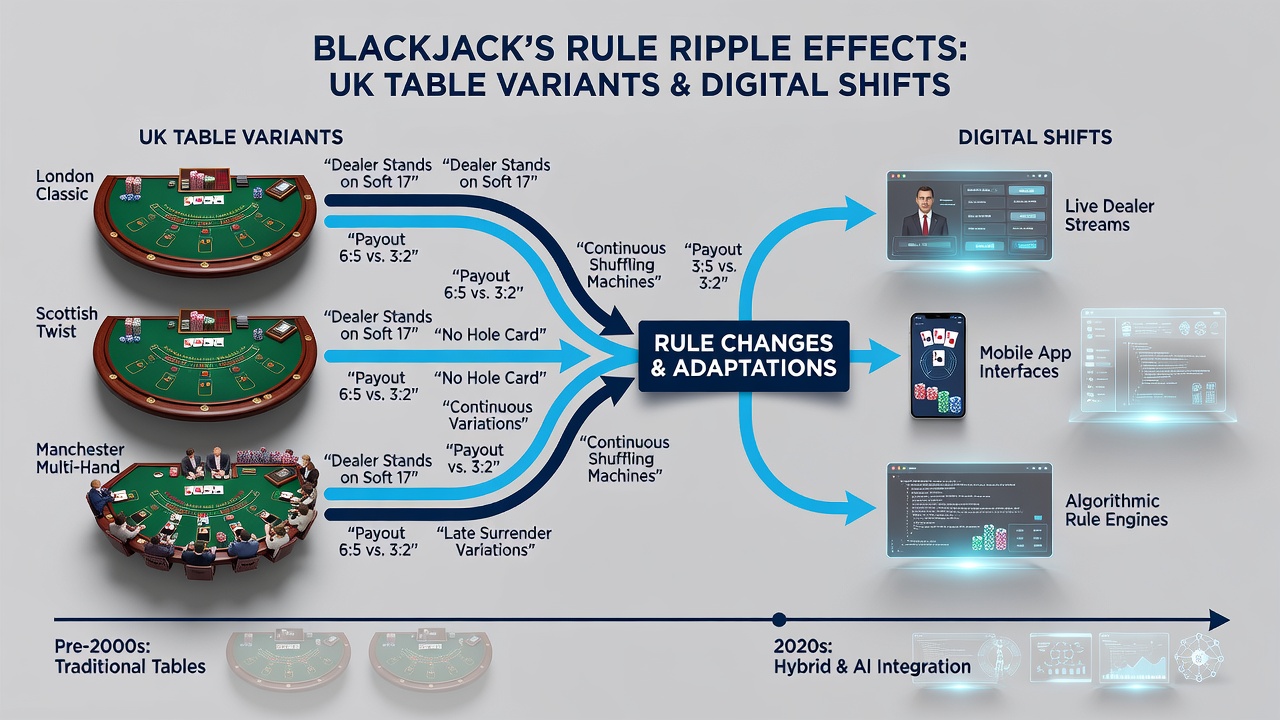 Transition to digital formats accelerates rule experimentation because software updates require less physical reconfiguration than casino floor changes. Operators test new combinations through limited-time promotions or segmented lobbies, then roll successful variants to broader audiences. One study released by an Australian research center examined thousands of online sessions and found that tables advertising favorable doubling rules retained players 12 percent longer than stricter alternatives even when overall house edges differed by only 0.25 percent. The retention effect appears tied to perceived player agency rather than actual return percentages. Live dealer streams add another dimension because camera angles and table layouts influence how quickly participants recognize rule differences. European blackjack streams popular with UK viewers typically enforce no-hole-card rules that interact with early surrender options, creating decision trees distinct from American-style games with hole cards. Those monitoring stream analytics note viewership spikes when operators highlight rule distinctions in pre-game overlays, suggesting informed players actively seek configurations that match their preferred strategies. Regulatory frameworks outside the UK also shape available options. Nevada Gaming Control Board records demonstrate how rule standardization across jurisdictions influences software development pipelines that later reach European markets. When a major provider adopts a rule set validated in one region the same parameters often migrate to UK-facing platforms within months because code reuse reduces implementation costs. This cross-border flow produces gradual convergence on certain rule clusters even as operators maintain niche variants to capture distinct player segments. Conclusion
Rule variations continue to propagate across UK blackjack landscapes because each adjustment alters expected values in predictable ways that both operators and players track through available data. Physical tables maintain established configurations while digital environments enable rapid testing and wider distribution of alternative sets. By July 2026 the interplay between these formats will likely intensify as more platforms integrate player-facing rule selectors that surface the ripple effects directly in search results and lobby displays.
Transition to digital formats accelerates rule experimentation because software updates require less physical reconfiguration than casino floor changes. Operators test new combinations through limited-time promotions or segmented lobbies, then roll successful variants to broader audiences. One study released by an Australian research center examined thousands of online sessions and found that tables advertising favorable doubling rules retained players 12 percent longer than stricter alternatives even when overall house edges differed by only 0.25 percent. The retention effect appears tied to perceived player agency rather than actual return percentages. Live dealer streams add another dimension because camera angles and table layouts influence how quickly participants recognize rule differences. European blackjack streams popular with UK viewers typically enforce no-hole-card rules that interact with early surrender options, creating decision trees distinct from American-style games with hole cards. Those monitoring stream analytics note viewership spikes when operators highlight rule distinctions in pre-game overlays, suggesting informed players actively seek configurations that match their preferred strategies. Regulatory frameworks outside the UK also shape available options. Nevada Gaming Control Board records demonstrate how rule standardization across jurisdictions influences software development pipelines that later reach European markets. When a major provider adopts a rule set validated in one region the same parameters often migrate to UK-facing platforms within months because code reuse reduces implementation costs. This cross-border flow produces gradual convergence on certain rule clusters even as operators maintain niche variants to capture distinct player segments. Conclusion
Rule variations continue to propagate across UK blackjack landscapes because each adjustment alters expected values in predictable ways that both operators and players track through available data. Physical tables maintain established configurations while digital environments enable rapid testing and wider distribution of alternative sets. By July 2026 the interplay between these formats will likely intensify as more platforms integrate player-facing rule selectors that surface the ripple effects directly in search results and lobby displays.
Blackjack rules create measurable shifts in house edges across UK table formats, and these adjustments extend into digital environments where software providers implement the same parameters at scale. Data from industry reports indicate that variations in deck count, dealer actions on soft seventeen, and doubling restrictions alter expected returns by fractions of a percent that compound over thousands of hands. Observers note these differences appear consistently between land-based venues in London and Manchester and their online counterparts operated through licensed platforms. Traditional UK tables often operate with six or eight decks while European-style games restrict doubling to hard totals of nine through eleven. Such constraints raise the house edge by 0.2 to 0.4 percent according to probability models published in gaming mathematics literature. In contrast, tables allowing double after split reduce that margin because players gain flexibility on paired hands. Researchers at academic institutions tracking casino mathematics have documented these patterns across hundreds of rule combinations and confirmed the effects remain stable regardless of venue type. Digital platforms replicate these rule sets through RNG systems yet introduce additional layers of variation. Some operators adjust deck penetration rates or shuffle frequencies to match land-based conditions, while others modify payout structures on side bets that accompany core games. Figures from European gaming associations reveal online blackjack sessions in the UK increased by 18 percent between 2024 and 2025, driven partly by players seeking specific rule combinations unavailable at nearby physical tables. By July 2026 analysts expect further migration as mobile interfaces incorporate real-time rule filters that let users sort tables by parameters such as number of decks or surrender availability. Multi-deck games dominate both physical and virtual UK offerings because they slow card counting and stabilize revenue for operators. Single-deck variants surface occasionally in high-limit rooms or specialized online lobbies, yet their lower house edges attract fewer tables overall. Those who study table distribution patterns report single-deck options represent less than 5 percent of active blackjack positions across major UK operators. The scarcity persists even though players recognize the mathematical advantage because operational costs and regulatory oversight favor multi-deck formats that reduce volatility. Dealer hit or stand decisions on soft seventeen produce another clear ripple. When dealers hit soft seventeen the house edge climbs by roughly 0.2 percent compared with stand-on-soft-seventeen rules. UK land-based casinos display this choice prominently on table signage, and online interfaces embed the same information in game rules pop-ups. Players who compare multiple sites discover that several major platforms switched to stand-on-soft-seventeen across select live-dealer streams in late 2025, a change that aligned their offerings more closely with certain international standards tracked by Canadian regulatory summaries. Doubling and splitting restrictions further differentiate table variants. Games that prohibit doubling on soft hands increase the house edge by 0.1 to 0.15 percent while limits on resplitting pairs compound the effect across multiple hands. Digital providers sometimes bundle these restrictions with progressive side bets that offset the stricter core rules through higher theoretical returns on those wagers. Industry data compiled by trade groups show such hybrid offerings maintain steady player volumes because the added features mask underlying rule impacts until extended sessions reveal the cumulative difference.
Transition to digital formats accelerates rule experimentation because software updates require less physical reconfiguration than casino floor changes. Operators test new combinations through limited-time promotions or segmented lobbies, then roll successful variants to broader audiences. One study released by an Australian research center examined thousands of online sessions and found that tables advertising favorable doubling rules retained players 12 percent longer than stricter alternatives even when overall house edges differed by only 0.25 percent. The retention effect appears tied to perceived player agency rather than actual return percentages. Live dealer streams add another dimension because camera angles and table layouts influence how quickly participants recognize rule differences. European blackjack streams popular with UK viewers typically enforce no-hole-card rules that interact with early surrender options, creating decision trees distinct from American-style games with hole cards. Those monitoring stream analytics note viewership spikes when operators highlight rule distinctions in pre-game overlays, suggesting informed players actively seek configurations that match their preferred strategies. Regulatory frameworks outside the UK also shape available options. Nevada Gaming Control Board records demonstrate how rule standardization across jurisdictions influences software development pipelines that later reach European markets. When a major provider adopts a rule set validated in one region the same parameters often migrate to UK-facing platforms within months because code reuse reduces implementation costs. This cross-border flow produces gradual convergence on certain rule clusters even as operators maintain niche variants to capture distinct player segments. Conclusion
Rule variations continue to propagate across UK blackjack landscapes because each adjustment alters expected values in predictable ways that both operators and players track through available data. Physical tables maintain established configurations while digital environments enable rapid testing and wider distribution of alternative sets. By July 2026 the interplay between these formats will likely intensify as more platforms integrate player-facing rule selectors that surface the ripple effects directly in search results and lobby displays.