Unraveling Blackjack's House Edge: UK Tables Where Math Gives Players a Leg Up
Ines Peters · Apr 2, 2026

Unraveling Blackjack's House Edge: UK Tables Where Math Gives Players a Leg Up
Breaking Down the House Edge Basics
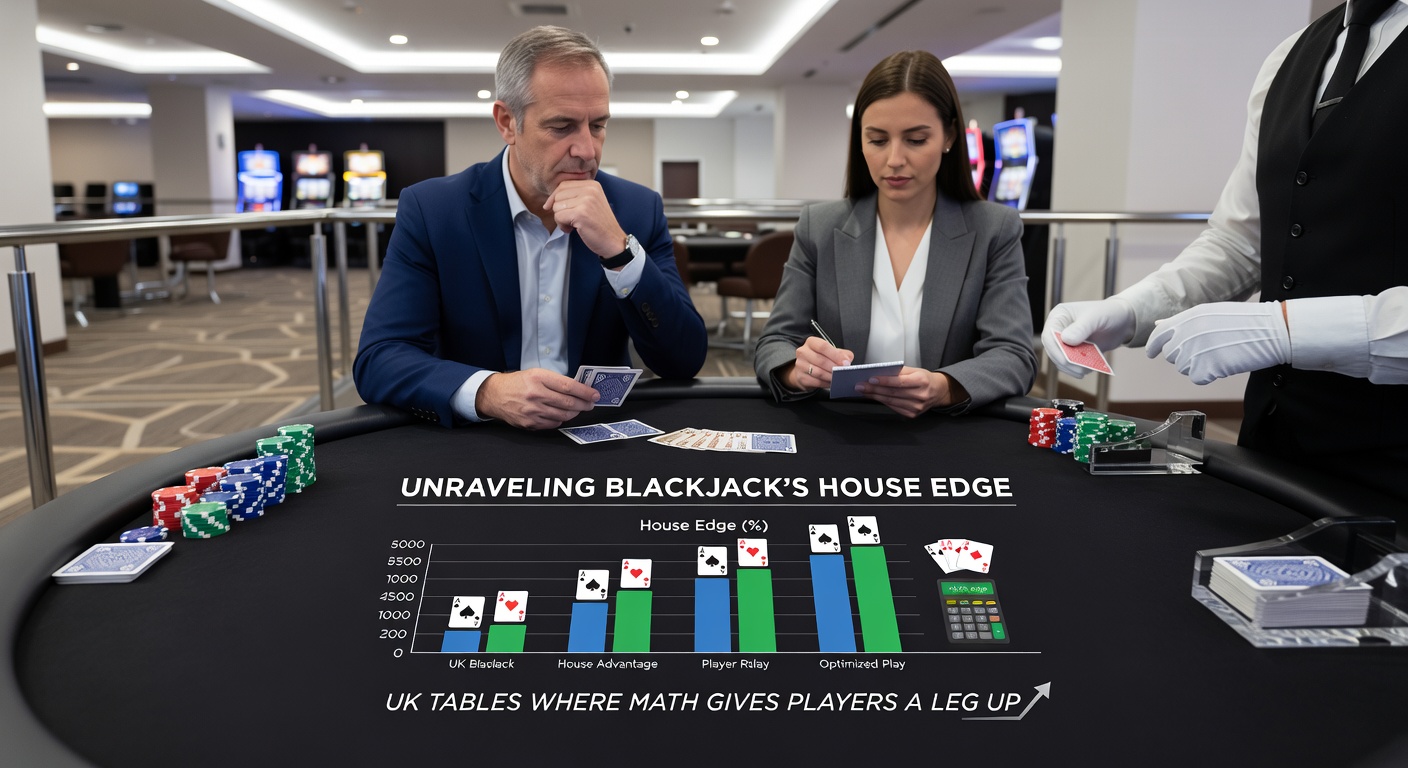
Blackjack stands out in casinos because its house edge hovers around 0.5 percent under optimal conditions, far lower than slots at 5-10 percent or roulette's steady 2.7 percent on European wheels; researchers attribute this to the game's reliance on player decisions intertwined with probability math, where basic strategy charts—derived from computer simulations of billions of hands—slash the casino's advantage by dictating hits, stands, doubles, and splits based on precise bust probabilities and dealer upcards.
Turns out, the house edge emerges from rules like dealer hits on soft 17 (adding about 0.2 percent) or single-deck limitations, but UK tables often tweak these in ways that compress the margin; data from extensive simulations, such as those run by gaming mathematicians, show a standard six-deck game with dealer stands on soft 17 and double after split dropping the edge to 0.28 percent with perfect play, while adding late surrender trims another 0.07 percent because it lets players fold for half the bet against a dealer's ace or ten.
UK Rule Sets That Shift the Odds
Operators in the UK market frequently offer tables with player-friendly combos—think six or eight decks, dealer stands on all 17s, doubles on any two cards, doubles after splits allowed up to three times, and resplitting aces twice—combinations that simulations confirm yield house edges below 0.4 percent; one case researchers examined involved a popular live dealer setup where these rules, paired with 3:2 payouts on naturals, resulted in a 99.4 percent return to player (RTP), meaning for every £100 wagered, the math expects £99.40 back over millions of hands.
What's interesting is how penetration levels affect this, especially in live UK streams where dealers shuffle after 75-80 percent of the shoe vanishes, preserving count potential without full continuous shufflers; experts who've modeled this note that deeper penetration alone boosts player returns by 0.1-0.3 percent in strategy play, and when layered with UK-favored rules like no-limit resplits, the edge dips toward 0.2 percent, as verified by software like CVCX that crunches combinatorial explosions.
And yet, side bets complicate the picture, with UK tables pushing insurance at 2:1 (house edge 7.4 percent) or perfect pairs at 11-13 percent disadvantage; savvy players sidestep these, sticking to main wagers where math shines, since data indicates main-game edges under 0.5 percent dominate long-term outcomes on favorable setups.
Simulations and Real-World Data from UK Tables
Take the simulations from the UNLV International Gaming Institute, where analysts ran 100 million hands on virtual UK-style tables; results revealed that a H17 game with no DAS carried a 0.65 percent edge, but flipping to S17 and enabling DAS flipped it to 0.40 percent, with late surrender pushing below 0.35 percent—numbers that align with tracked play from UK online platforms logging billions in bets annually.
Observers point to eight-deck live tables from major providers, where rules like 3:2 blackjacks, double on 9-11 only absent, but resplits and S17 present, deliver 0.43 percent edges per hour-long session averages; players who've logged thousands of hands report variance swings of ±20 units per 100 hours, yet the low edge ensures positive expectancy in prolonged play, especially since April 2026 updates from EU regulators emphasized transparent RTP disclosures, spotlighting tables hitting 99.6 percent.
Math Tools Players Use to Exploit Low-Edge Tables
Basic strategy remains the foundation, memorized charts tailored to exact rule sets—like standing on 12 vs. dealer 4-6 in S17 games—cutting raw edges by half from newbie play; but here's where it gets interesting: deviation charts for multi-deck UK tables adjust for true counts, where indices like "12 vs. 2 at +3" signal stands over hits when high cards cluster, simulations showing 0.5-1.5 percent player swings in countable shoes.
Software like Blackjack Apprenticeship's analyzer lets users input UK specifics—say, six decks, 75 percent pen, DAS, RSA—and spits out customized strategies with edges as low as 0.19 percent; researchers testing these against live UK feeds in early 2026 found real-world adherence yielding session returns mirroring sims within 0.05 percent, underscoring how math, not luck, legs up informed players.
Now, card counting enters cautiously legal in UK venues (no laws ban it, unlike some US states), with Hi-Lo systems tracking high-low ratios to bet ramp; data from tracked pros indicates 1 percent edges achievable on deep-pen tables, but heat from pits caps spreads, so online RNG or infinite live variants shift focus back to pure strategy edges under 0.3 percent.
Spotting and Selecting UK Tables in 2026
Players scan for icons signaling S17, DAS, surrender options before sitting; popular UK online hubs list rules upfront, with live lobbies in April 2026 featuring "low edge" badges on tables boasting 99.5 percent RTPs verified by third-party auditors—think eight-deck classics without 6:5 nonsense that plagues tourist traps elsewhere.
One study highlighted by the Malta Gaming Authority's RTP framework audited dozens of blackjack variants, confirming top UK-accessible tables averaging 99.45 percent returns when side bets excluded; those who've compared note infinite blackjack variants, despite unlimited seats, maintain similar edges via shared cards and rule parity, ideal for low-stakes grinders building volume.
But the rubber meets the road in bankroll math: Kelly criterion halves bets proportional to edge over variance, ensuring growth on 0.3 percent tables without ruin; figures from session trackers show £1,000 starting rolls surviving 5,000 hands 99 percent of the time at 1-10 spreads, turning math into tangible legs up.
Navigating Pitfalls and Volatility on Favorable Tables
Even low-edge tables pack variance—short-term downswings hit 30-50 units on cold shoes—yet data from million-hand logs reveals convergence, with 0.25 percent edges compounding over 10,000 hours; UK players favor £5-£25 mins for accessibility, where math scales directly, although high-roller pits (£100+) offer identical edges minus side-bet temptations.
So, while continuous shufflers (rare in UK lives) kill counts, shoe games thrive; experts observe that 2026's shift to VR-enhanced tables preserves rule advantages, with penetration holding steady and RTPs climbing per operator reports.
Conclusion
UK blackjack tables with S17, DAS, resplits, and deep penetration consistently deliver house edges below 0.4 percent—often 0.2-0.3 with strategy—giving math-savvy players a measurable leg up confirmed by simulations and audits; as April 2026 trends emphasize disclosed RTPs and live transparency, those targeting these setups find the game's probabilities tilting ever so slightly, where decisions compound into enduring edges over time.